

Already a member?
Sign inBecome part of the foremost online community!
Sign Up NowOr, download the The Glaucoma Community app on your phone


Prevent Blindness, NEI, and others
Sports-related eye injuries are more common than you may think. Learn which activities carry more risk, how protective eyewear can help, and when to talk with your eye doctor.
Regular physical activity is an important part of staying healthy, and having glaucoma does not mean you have to give up the sports or activities you enjoy. But eye injuries can happen quickly during sports, and in some cases, they can cause serious damage or even lead to a type of glaucoma called traumatic glaucoma. If you live with glaucoma, protecting the vision you have is especially important.
The good news is that many sports-related eye injuries can be prevented. Here is what to know about the risks, the role of protective eyewear, and how you can stay active while protecting your eyes.
According to Prevent Blindness, more than 44,000 sports-related eye injuries were treated in the United States in 2025. Among people age 15 and older, basketball caused the highest number of sports-related eye injuries.
Even professional athletes are not immune.
A study looking at facial injuries in the NBA over five seasons found 440 facial injuries among 263 players. The eye and surrounding area was the most commonly injured location, accounting for 37% of those injuries. Eye-related injuries also caused more missed games than injuries to any other facial area.
Another NBA study found 30 significant eye injuries over eight seasons that led to 106 missed games. Researchers noted that orbital fractures—breaks in the bones around the eye—caused players to miss considerably more time than minor cuts or bruises.
These numbers involve elite athletes, but the lesson applies to recreational sports as well: a finger, elbow, ball, racquet, or other impact can cause a serious eye injury in seconds.
The National Eye Institute considers sports such as basketball, baseball, hockey, racquetball, squash, paintball, and some water sports to have a higher risk of eye injury. Football, soccer, tennis, golf, and badminton are considered moderate-risk activities.
An eye injury can do more than cause temporary swelling or a black eye.
A hard blow to the eye may damage the structures that control how fluid drains from the eye. This can cause eye pressure to rise and may eventually lead to traumatic glaucoma. Importantly, glaucoma caused by an injury does not always appear immediately. In some people, increased eye pressure and glaucoma can develop months or even years after the original injury.
The Glaucoma Research Foundation specifically recommends protecting your eyes during sports because eye injuries can lead to traumatic or secondary glaucoma.
For someone who already has glaucoma, avoiding additional eye damage becomes even more important.
Protective eyewear can make a major difference. The National Eye Institute reports that appropriate protective eyewear can prevent 9 out of 10 sports-related eye injuries in children, highlighting just how effective proper protection can be.
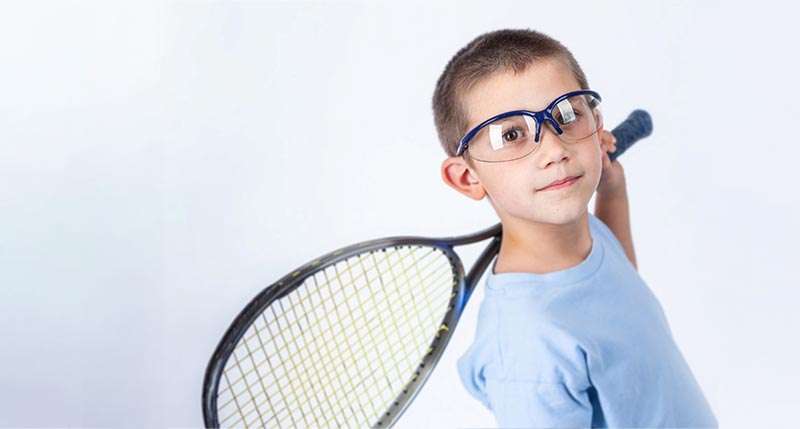
Regular glasses and sunglasses are not designed to protect your eyes from high-speed impact. For sports such as basketball, soccer, racquetball, and squash, the NEI recommends sports goggles made with strong polycarbonate lenses. Protective equipment varies by sport and may include goggles, helmets, face shields, or face masks.
If you need prescription lenses, many sports goggles can also be made with your prescription.
Having glaucoma usually does not mean giving up exercise. In fact, moderate physical activity may be beneficial for overall health and may temporarily lower eye pressure in some people. Walking, jogging, and other moderate activities are commonly recommended.
👉🏼 Learn more: Exercise and Sports with Glaucoma: Do’s and Don’ts
However, certain activities deserve more caution.
Heavy weightlifting, especially when you hold your breath and strain, can temporarily increase pressure inside the eye. Inverted yoga positions such as headstands can also raise eye pressure. If these activities are part of your routine, ask your eye doctor whether any changes are appropriate for you.
Swimming can generally be a good form of exercise, but the Glaucoma Research Foundation notes that very tight swimming goggles may increase eye pressure.
You should also ask your ophthalmologist about sports if you have recently had glaucoma surgery. Your eye may need extra protection while it heals, and strenuous activity, swimming, heavy lifting, or contact sports may need to be limited temporarily. Your surgeon can tell you when it is safe to return.
If you are hit in the eye during a game, do not assume everything is fine just because you can still see. Sudden blurry vision, severe pain, flashes or new floaters, bleeding, significant swelling, loss of vision, or a noticeable change in the appearance of the eye should be evaluated promptly.
Sports and exercise can still be an important—and enjoyable—part of life with glaucoma. The goal is not to avoid activity. It is to reduce preventable risks.
Wear sport-appropriate eye protection, be especially careful with activities where balls, racquets, fingers, or elbows can hit the eye, and talk with your eye doctor if you are unsure whether a particular sport is safe for you.
Your eyes already have enough work to do managing glaucoma. Giving them a little extra protection on the court, field, or gym is worth it.
References
The information provided by The Glaucoma Community is for educational purposes only and does not replace professional medical advice. Always talk with your healthcare provider before making changes to your treatment or care. The Glaucoma Community does not endorse specific treatments, providers, or products.
Source: {{articlecontent.article.sourceName}}
Receive daily updated expert-reviewed article summaries. Everything you need to know from discoveries, treatments, and living tips!
Already a Responsum member?
Available for Apple iOS and Android


We've sent a report to our community managers who will take the necessary steps. This member will be removed form your Community Chat and will no longer be able to message you.
Please contact us if you have any questions.
Add Comments
Cancel